"I'm Still Alive" — And Why Luck Is Not a Safety System
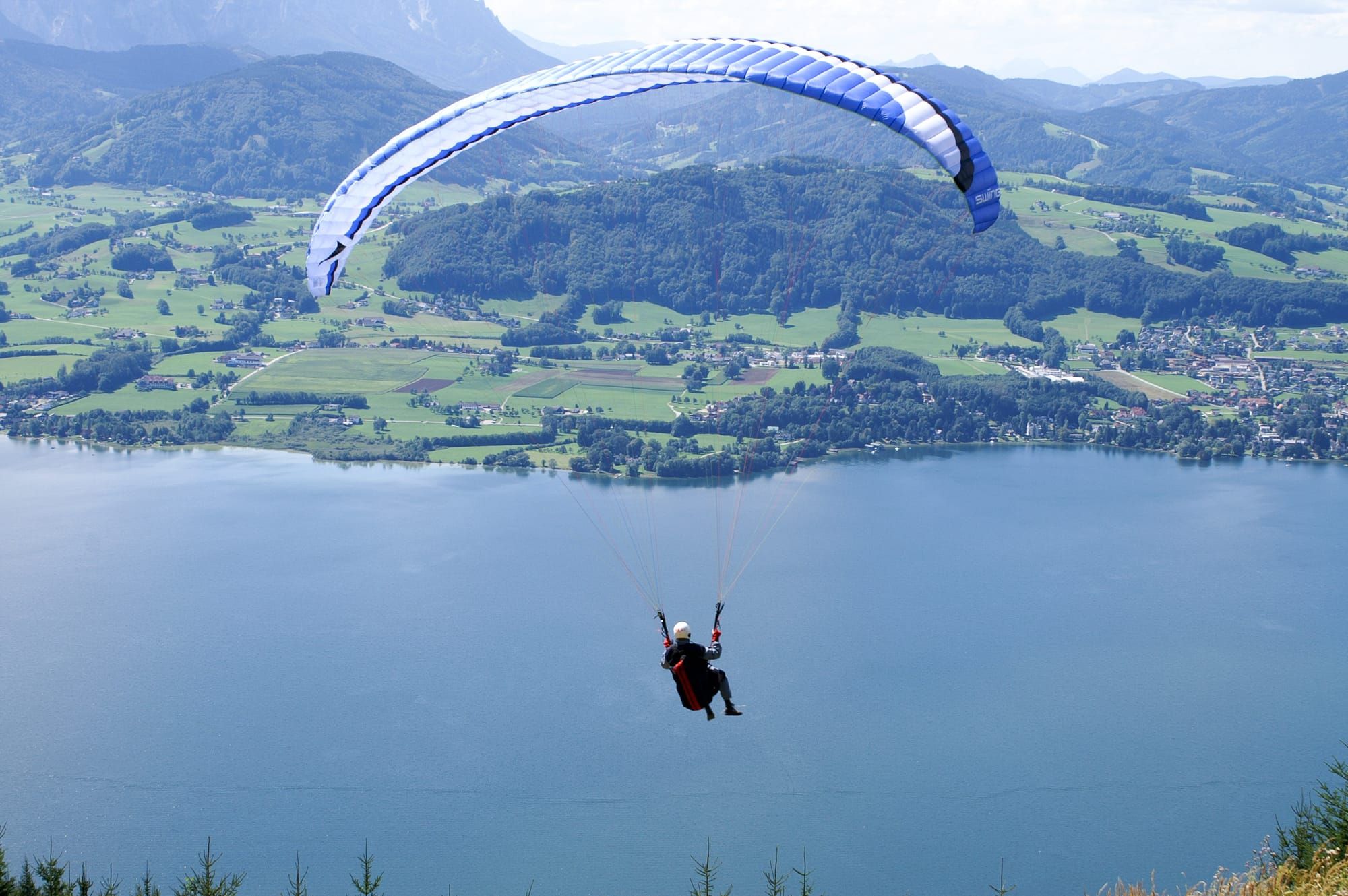
Saturday, 24th May 2026. Piesendorf, Pinzgau. Clear skies, good visibility, alpine thermals doing exactly what alpine thermals do on a summer afternoon. A 44-year-old paraglider pilot from Upper Austria has launched from the Schmittenhöhe and is quietly floating above the Pinzgauer Hütte. A 28-year-old from Tyrol is at the controls of a Cessna 172, enjoying an alpine scenic flight — the kind you book because the Alps from the air are, quite frankly, unreasonably beautiful.
And then the Cessna arrives from behind.
The propeller shreds the paraglider's canopy completely. The woman is thrown spinning and screaming through the air. She had been filming with her helmet camera, and the footage — which she subsequently posted to Instagram under the caption "Happy 2nd Birthday to me" — is simultaneously the most spectacular and most deeply unsettling piece of aviation footage you will watch this week. Within seconds, she deploys her reserve parachute. She lands hard on a forest road. Her first words: "I leb no." Which, for the non-Austrian-German speakers in the room, translates as: "I'm still alive."
The Cessna pilot also lands safely — with paraglider lines and fabric fragments wrapped around his aircraft, but otherwise unharmed.
Both walked away. Both were extraordinarily, statistically improbable, not-to-be-relied-upon lucky.
And luck, to be absolutely clear, is not a safety system.
What the Mountain Police Said — and What They Didn't
ORF Salzburg covered the story extensively. The causes remain unclear, investigations are ongoing. Christoph Lindenthaler of the Alpinpolizei dutifully notes that "a motorised aircraft is fundamentally required to yield to a non-motorised one." The managing director of Zell am See airfield, Florian Schett, points out that the airspace around Zell am See is "completely free airspace" — nothing is restricted, everyone may use it equally, and his airfield has de facto no influence whatsoever over who flies where and at what altitude.
All of this is accurate. All of it is also the most comfortable thing one can say in the circumstances.
What nobody said: that this collision could, with very high probability, have been prevented by technology that is available today, has been available for years, and costs roughly the same as a moderately ambitious weekend away.
See and Avoid Doesn't Work Backwards
Batty flies. IFR training, ATPL in progress, a few hundred hours across Europe in various metal tubes of varying levels of modernity. And one of the things you learn very early in flight training — almost disturbingly early, given how cheerfully you were handed the controls moments before — is the fundamental limitation of the "see and avoid" principle: you can only see what is in front of you.
The paraglider had no chance of seeing the Cessna. It came from behind. The Cessna pilot states he could not avoid in time — meaning he either spotted her too late, or the geometry of the approach from the Glemmtal valley towards Zell am See simply gave him no viable window to react. On a summer Saturday afternoon above the Schmittenhöhe, in thermically active terrain, with a paraglider drifting in the wind gradient and a Cessna turning onto final approach to its next waypoint — this is not an edge case. This is a perfectly ordinary afternoon in the Austrian Alps.
The Alpine airspace is among the busiest low-level flying environments in the world. Sailplanes, motor gliders, paragliders, hang gliders, helicopters, small GA aircraft, hot air balloons, increasingly drones — all sharing the same uncontrolled airspace, operating at wildly different speeds and manoeuvrability envelopes, collectively relying on the human eye as their primary collision avoidance system.
The human eye has a significant blind spot. It always has.
FLARM and ADS-B: The Solution Already Exists
FLARM — developed in Switzerland, now fitted in over 50,000 aircraft worldwide — is a radio-based collision warning system. Every equipped device within range forms an ad-hoc network, continuously broadcasting position and trajectory data. When two flight paths are converging on a collision course, both pilots receive an alert. Not seconds before impact. Minutes before. With enough time to actually do something useful, like not flying into each other.
PowerFLARM goes further still: it also receives ADS-B and Mode-C/S transponder signals, covering the majority of IFR and commercial traffic as well. Range exceeding 10 kilometres. Price for a solid installation: a few hundred euros, depending on configuration. Lighter than a decent thermos flask.
France has made FLARM mandatory for gliders. Switzerland has near-universal FLARM penetration in sailplanes, with helicopters following rapidly. Germany has been progressively tightening requirements. In Austria, FLARM for paragliders and small GA aircraft is... voluntary. A recommendation. A sensible suggestion. Something one might consider if one is of a particularly safety-conscious disposition.
Had the Cessna pilot been equipped with PowerFLARM — and had the paraglider been carrying a FLARM-capable vario — the system would have triggered minutes before the collision. Warning. Course correction. No story. No Instagram video. No hospital visit. No investigation.
Austria: Regulations Everywhere — Except Here
Batty lives in Austria, flies in Austria, and has developed a certain affectionate familiarity with the Austrian civil aviation regulatory apparatus. And with considerable confidence, Batty can say: Austria is not shy about regulating general aviation.
Forms. Permits. Proof of competency. Licensing requirements at multiple tiers. Medical fitness certificates of a specificity that would challenge a junior endocrinologist. The bureaucratic infrastructure surrounding flight operations in Austria is genuinely impressive in its thoroughness.
And then: open, uncontrolled airspace above one of the most heavily used alpine valleys in Europe. No mandatory electronic conspicuity requirement. No minimum equipment standard for collision avoidance in high-density airspace. No regulatory consequence drawn from a sequence of near-misses and actual incidents that have been accumulating over the Alps for years.
This is not an oversight. This is a gap. And gaps in safety systems do not close themselves.
Austria will require a mountain guide to carry a specific harness buckle of a specific tensile strength. It will require a commercial balloon pilot to hold certificates that would impress an aviation authority twice its size. But it will not require a Cessna on a VFR tour over the Pinzgau to be electronically visible to the paraglider pilot whose canopy is directly in its flight path.
The regulatory logic here is, to put it generously, incomplete.
What Should Actually Happen
The ask is not complicated:
Mandatory FLARM and/or ADS-B Out equipment for all motorised aircraft operating VFR below — let's say — FL140 in Austrian alpine terrain. And a clear transition timeline, with a sunset date, for the same requirement to apply to unpowered airspace users including paragliders and hang gliders operating in the same zones.
The cost is manageable. The technology is certified and mature. The hardware is small, light, and requires no specialist installation knowledge. And the benefit is not theoretical — it is demonstrably, evidently real on every clear Saturday afternoon above the Schmittenhöhe.
The alternative is the current arrangement: shared free airspace, personal responsibility, collective hope, and the occasional video going viral because someone was fortunate enough to survive and had the presence of mind to document it.
Batty finds that alternative insufficient.
Postscript
The paraglider from Upper Austria is, by all reports, recovering from light injuries. She is clearly experienced, technically competent, and possessed of a composure under pressure that Batty would welcome in any cockpit. Her post-incident commentary — "I'm still alive" — is a piece of situation reporting of a brevity and precision that no amount of formal training can manufacture.
But "I'm still alive" should not be the metric against which we measure the adequacy of our airspace management over the Austrian Alps.
The authorities know what the technology can do. They know what the airspace above Zell am See looks like at one in the afternoon in May. They know what FLARM costs and how it works.
What is missing is the political and regulatory will to turn awareness into obligation — before the next piece of footage ends not with a reserve parachute deployment, but with something considerably harder to recover from.
Batty flies on. Transponder on. ADS-B out. FLARM active. Because it's the right thing to do — even when it isn't yet the required one.
Sources: ORF Salzburg — Causes of Spectacular Mid-Air Incident Still Unclear | Instagram video by the paraglider pilot | FLARM Technology | EASA ADS-B Requirements