The Music Was Free. The Lawsuit Was Not.
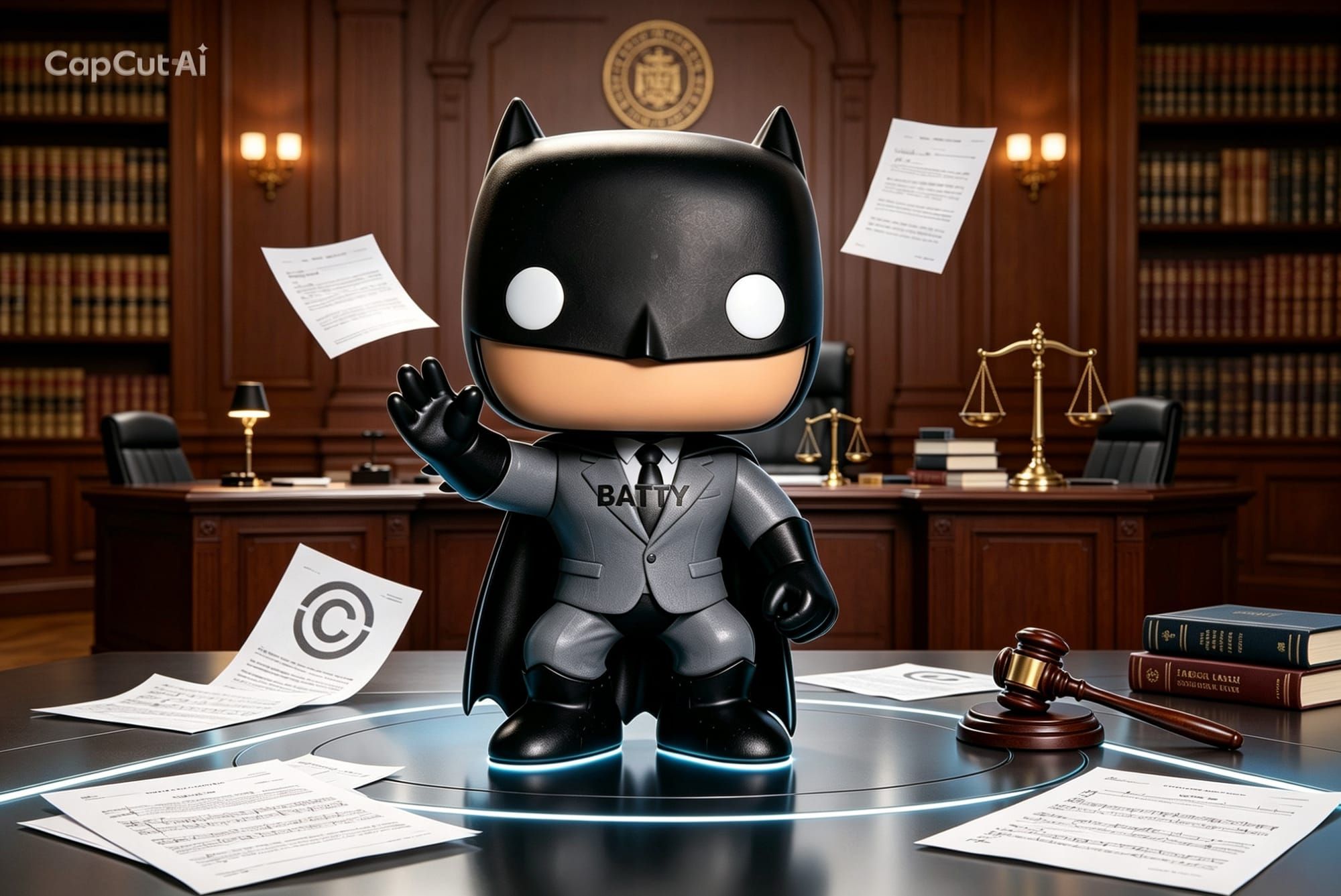
What Every Social Media Creator Needs to Know About Licensing — Before It Gets Expensive
Let's have a brief, important, and occasionally alarming conversation about copyright.
Not because Batty is a lawyer. Batty is not a lawyer. Batty is a private pilot with strong opinions about espresso and an interest in not receiving cease-and-desist letters. These things are compatible. The following is for informational purposes, and if you have a specific legal situation, please consult an actual solicitor rather than a bat with a blog.
With that established: here is something that catches a remarkable number of creators off guard.
The Platform License Is Not Your License
TikTok has a music library. Instagram has a music library. YouTube has Content ID. They all have deals with the major labels — Universal, Sony, Warner — which allow their users to add music to videos posted on that specific platform.
The critical word is: specific.
The licence that lets you add a Taylor Swift track to your TikTok video does not transfer to Instagram. It does not transfer to YouTube. It does not transfer to your website, your WhatsApp status, or a presentation at your company offsite. When you take that video — the one TikTok licensed perfectly legitimately — and upload it elsewhere, you are, legally speaking, starting again from zero.
This is not a technicality. It is the entire architecture of how platform licensing works. Each platform negotiates its own deal, for its own users, on its own service. The rights end at the edge of that platform.
A marketing team discovers this the hard way with some regularity. They create content on TikTok, it performs well, they repurpose it to Instagram and YouTube as any reasonable person would. Each of those reposts is, potentially, a separate copyright infringement.
What Happens When It Goes Wrong
The numbers are not trivial.
Under US copyright law, statutory damages run from $750 to $30,000 per infringement** — per song, per post. For willful infringement — meaning you knew what you were doing — that ceiling rises to **$150,000 per work.
In 2023, Sony Music sued Marriott Hotels for using music without proper licensing in influencer campaigns. The claimed damages: over $139 million. That is not a typo.
In Germany and Austria, the Abmahnung system means that even smaller infringements can generate cease-and-desist letters with legal fees of €1,000 to €5,000 or more, before any damages are considered.
For individual creators — not hotel chains — the consequences are usually less financially catastrophic but still meaningful: videos muted or removed, accounts restricted, monetisation suspended, and in repeat cases, accounts terminated entirely. TikTok, YouTube, and Instagram all operate automated detection systems that check every upload against copyright databases. They are not slow, and they are not forgiving.
Why Battyontour.com Is Mostly Photos
You will notice, if you look at this site with any attention, that it does not contain many videos. The videos that do appear use original content with no third-party music, or music that is properly licensed for web use.
This is intentional, and the reason is exactly the above.
The photos you see here were taken by Batty. That makes the copyright situation straightforward: Batty took the photo, Batty owns the rights, Batty publishes the photo. No negotiations required.
The TikTok account and the Instagram account are currently private — not because the content isn't worth sharing, but because the licensing infrastructure required to publish video content across multiple platforms, with music, legally, is genuinely complex and worth understanding properly before proceeding publicly at scale.
This is not fear. It is organisation.
The Rule
One practical principle that prevents most problems:
Check the licence. Every time. For every platform. Separately.
If a piece of music is cleared for TikTok through TikTok's commercial library — it is cleared for TikTok. Not for Instagram, not for your website, not anywhere else. If you want it elsewhere, you need a separate licence for elsewhere.
If you want music that works across platforms without per-platform licensing, the answer is royalty-free music with explicit multi-platform licences — Epidemic Sound, Artlist, and similar services exist precisely for this purpose and have become considerably more comprehensive in recent years. The annual subscription cost is substantially less than a single Abmahnung.
The Frontier: AI-Generated Content
This is where it gets genuinely interesting — and genuinely unresolved.
In 2024, the RIAA sued AI music generators Suno and Udio on behalf of Universal, Sony, and Warner, arguing that training these models on copyrighted recordings constitutes infringement. By late 2025, UMG and Warner had settled with Udio and Suno respectively, with multi-million dollar payments and licensing partnerships. Sony's case was still live as of mid-2026.
The US Copyright Office issued a report in May 2025 stating clearly that "fair use does not excuse unauthorised training on expressive works, particularly when used to generate substitutional outputs." The legal direction of travel is becoming clearer: AI-generated music is not automatically copyright-free, and the tools used to generate it carry their own legal histories.
For photographs: AI-generated images currently exist in a legally ambiguous space in most jurisdictions. They may not qualify for copyright protection in the same way as human-created works, but they may also inadvertently incorporate elements of training data that carry third-party rights. The law is moving, and it is not moving slowly.
What this means practically: if you are using AI-generated music, images, or video in commercial or public-facing content, the correct answer is the same as for everything else — read the terms of service of the tool you used, understand what licence it grants you, and verify that licence covers your intended use.
Batty Will Keep Watching This
The intersection of AI, creative content, and intellectual property law is one of the more consequential legal stories of the next decade. The outcomes of the cases currently working through courts in the US and the regulatory frameworks being developed under the EU AI Act will define what creators can do, and on what terms, for years.
We will follow it. We will report on it. And in the meantime, the photos on this site will continue to be taken by Batty, with Batty's camera, in places Batty actually went.
It is, as legal strategies go, reasonably solid.
This article is for general informational purposes and does not constitute legal advice. For specific situations involving copyright, please consult a qualified intellectual property lawyer. 🦇
battyontour.com